You are not logged in.
- Topics: Active | Unanswered
#1 2026-04-27 14:06
- seb3773
- Member

- From: France
- Registered: 2023-11-01
- Posts: 285
tdeParted : a partition editor based on GParted for Trinity Desktop
Hello 

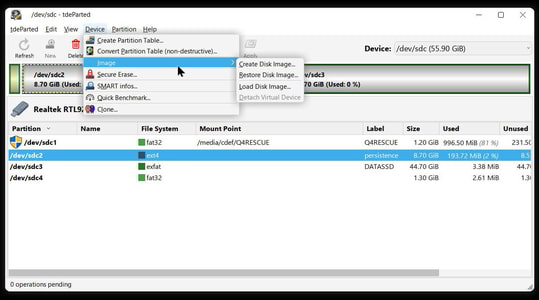
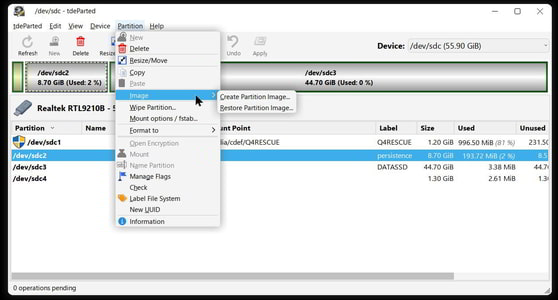
tdeParted is based on GParted (https://github.com/GNOME/gparted). Originally intended as a TQt3 port of GParted, several features not present in GParted have been added. These include a secure erase function, a summary of S.M.A.R.T. information for compatible devices, a quick benchmark to get an idea of a drive’s read and write performance (not a replacement for dedicated disk benchmarking tools, but useful for a quick estimate), creation and restoration of disk/partition images, device cloning, the ability to export a pending operation chain as a bash script, copy-to-clipboard support in key dialogs, and a graphical overhaul with improved ergonomics (a more complete toolbar, quick mount/unmount buttons for partitions, and other details). A big thank you to the authors of GParted, without whom this tool would obviously not exist.
Features
Partition management Create, delete, resize, move, copy, paste, check partitions, and manage partition flags.
Secure erase Securely erase a whole disk device.
S.M.A.R.T. summary Display a summary of S.M.A.R.T. information for compatible drives.
Quick benchmark Quick estimate of read/write performance.
Disk / partition imaging Create and restore disk or partition images.
Device cloning Clone a whole disk device to another one (requires an unused target device of equal or larger size). Optionally expand a partition after cloning in safe cases.
Export pending operations Export the current pending operation chain as a bash script.
Create / convert partition tables as pending operations Create a new partition table (MBR/GPT) or convert between MBR and GPT as a queued operation, executed only when applying pending operations. GPT to MBR conversion uses sgdisk and is limited to up to 4 partitions. A GPT backup is created under /var/tmp/ before conversion.
Copy to clipboard Copy textual reports from key dialogs (such as operation reports and device/partition information).
( https://github.com/seb3773/tdeparted )
deb package available on github (can't upload here, it's > 500KB)
As always, all criticism welcome!!
Screenshots: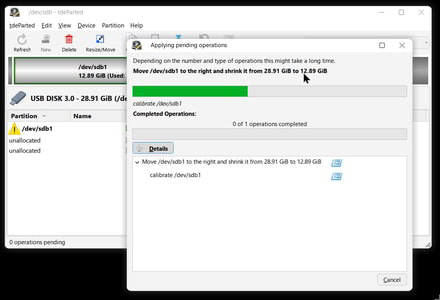
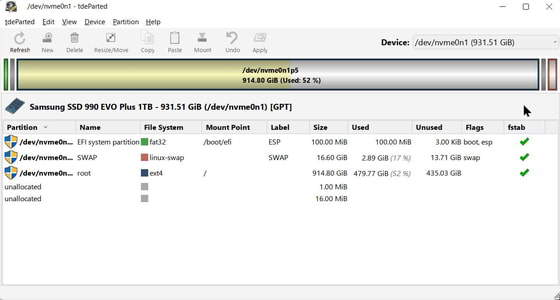
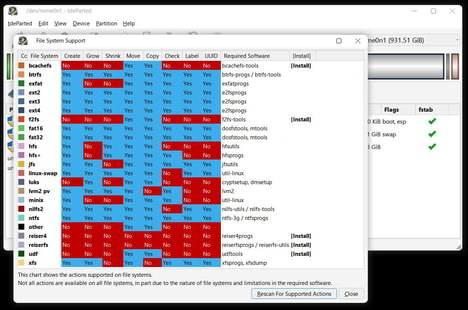
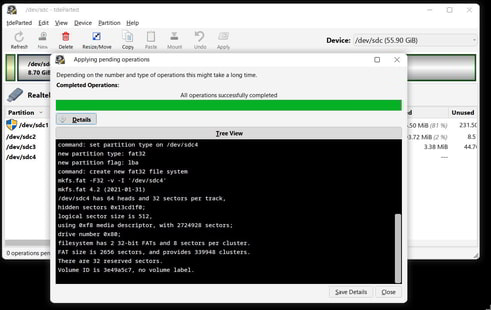
Last edited by seb3773 (2026-04-29 01:05)
Debian & Q4OS (TDE!!), low-level C, ASM (z80/68k/x86/ARM64), embedded systems, CPU architectures (RISC-V, binary formats, assembly), retro-computing, metal music, guitar and sci-fi.
Offline
#2 2026-04-28 14:30
- theasmitkid
- Member
- From: NCT of Delhi
- Registered: 2025-01-26
- Posts: 357
Re: tdeParted : a partition editor based on GParted for Trinity Desktop
I've been watching the repo since you created it, and its great!
Do add an AI_POLICY.md and LICENSE
Coding & Robotics Enthusiast | Windows 7 x86 @ n2600 · 2GB · 320GB HDD (No graphics acceleration available in linux)
Offline
#3 2026-04-28 16:41
- seb3773
- Member
- From: France
- Registered: 2023-11-01
- Posts: 285
Re: tdeParted : a partition editor based on GParted for Trinity Desktop
I've been watching the repo since you created it, and its great!
Do add an AI_POLICY.md and LICENSE
Thank you very much, this one wasn't so easy to port :-p
About AI_POLICY, I need to take a look at what's "pertinent".
On the whole, I’m not against using AI for coding or debugging, but I believe it must always be verified and supervised by a human.
My views on this have evolved slightly: I still think that having AI write large chunks of code is not a good idea for code quality, nor is it beneficial for the programmer, who could ultimately lose skills. That said, I think it would be short-sighted not to use AI if it helps improve code.
Let me clarify: I now frequently use AI for code reviews. I copy-paste or attach parts of my source code and ask for an extremely precise and well-argued review of potential errors, memory leaks, etc.
I don’t have access to paid models, but the free credits from GPT or Claude are enough for reasonable-sized code snippets (not entire projects, obviously). This gives me a kind of second pair of eyes—if you will—on my code.
Often, the AI points out possible errors that seem relevant (though of course, they must be rigorously verified, as the tool sometimes makes mistakes or misses context, leading to “false positives”) that I might not have spotted right away—or at all, depending on the case.
In this sense, I find it useful. These tools are like brute-force engines overall, but they can spot errors that aren’t immediately obvious to a human (at least, not to me! ^^), helping to improve or at least secure the code further.
Sometimes, I also use AI to look up C++ code snippets (I’m not a great C++ programmer; my go-to language is C, and I often hesitate about the “right” way to do things in C++). The goal is to avoid doing anything absurd in C++. But in all cases, I always want to understand what I’m doing. Copy-pasting code blindly or relying on “vibe coding” is out of the question. It’s essential to know what you’re doing and where you’re going, which means more than just a quick look—it requires a true understanding of the AI’s response.
...This is all a bit long and might be off-topic for this forum (though it is about development), but I’m not sure how to set rules for AI-assisted contributions. I’ve seen what some others are doing, and I’ll try to find a system that fits my approach: I don’t reject the tool as long as it’s used appropriately. After all, if someone points out a major bug in my code—and it’s totally relevant and verified—it doesn’t matter if they used AI to find it. The important thing is that the bug gets fixed!
What’s your take on this? (question for Q4OSTEAM too, as I'm working on a pure c++ (qt free) s4 snapshot backend/CLI, what are your thoughts about this and what policy do you want to enforce ?...)
Last edited by seb3773 (2026-04-29 01:05)
Debian & Q4OS (TDE!!), low-level C, ASM (z80/68k/x86/ARM64), embedded systems, CPU architectures (RISC-V, binary formats, assembly), retro-computing, metal music, guitar and sci-fi.
Offline
#4 2026-04-28 18:20
- theasmitkid
- Member
- From: NCT of Delhi
- Registered: 2025-01-26
- Posts: 357
Re: tdeParted : a partition editor based on GParted for Trinity Desktop
Well I'm not against using AI for coding either, I use free models of a few LLMs mainly for idea speculations, debugging, and providing example snippets for new libraries that are a little hard to understand just by the docs. (For example, I was looking for how global menus work on various platforms, and then I stumbled upon helloSystem).
I've seen a few repositories enforce strict no AI policy which seems pretty.. too much?
As for AI_POLICY for your project, i was referring to just mentioning something like "LLMs have been used for proofreading and debugging; However vibe coded PRs are strictly forbidden"
Didn't an AI find a couple 100 vulnerabilities in firefox recently? I think it's a good practice to analyse code via AI to find bugs and issues that might have been missed by humans.. so, no hate!
Only thing I am against is AI generated images; i personally find them displeasing to look at, and the amount of electricity and drinkable water it consumes to cool those computers is beyond absurd.
Once again, no hate to your work. You've been making really great and useful applications— which all have been tbh what I've been looking for in tde 
Coding & Robotics Enthusiast | Windows 7 x86 @ n2600 · 2GB · 320GB HDD (No graphics acceleration available in linux)
Offline
- Registered users online in this topic: 0, guests: 1